Skip to content
Safely and Precisely Unloading Full Shipping Containers with a Container Tilt Frame

Safely and Precisely Unloading Full Shipping Containers with a Container Tilt Frame

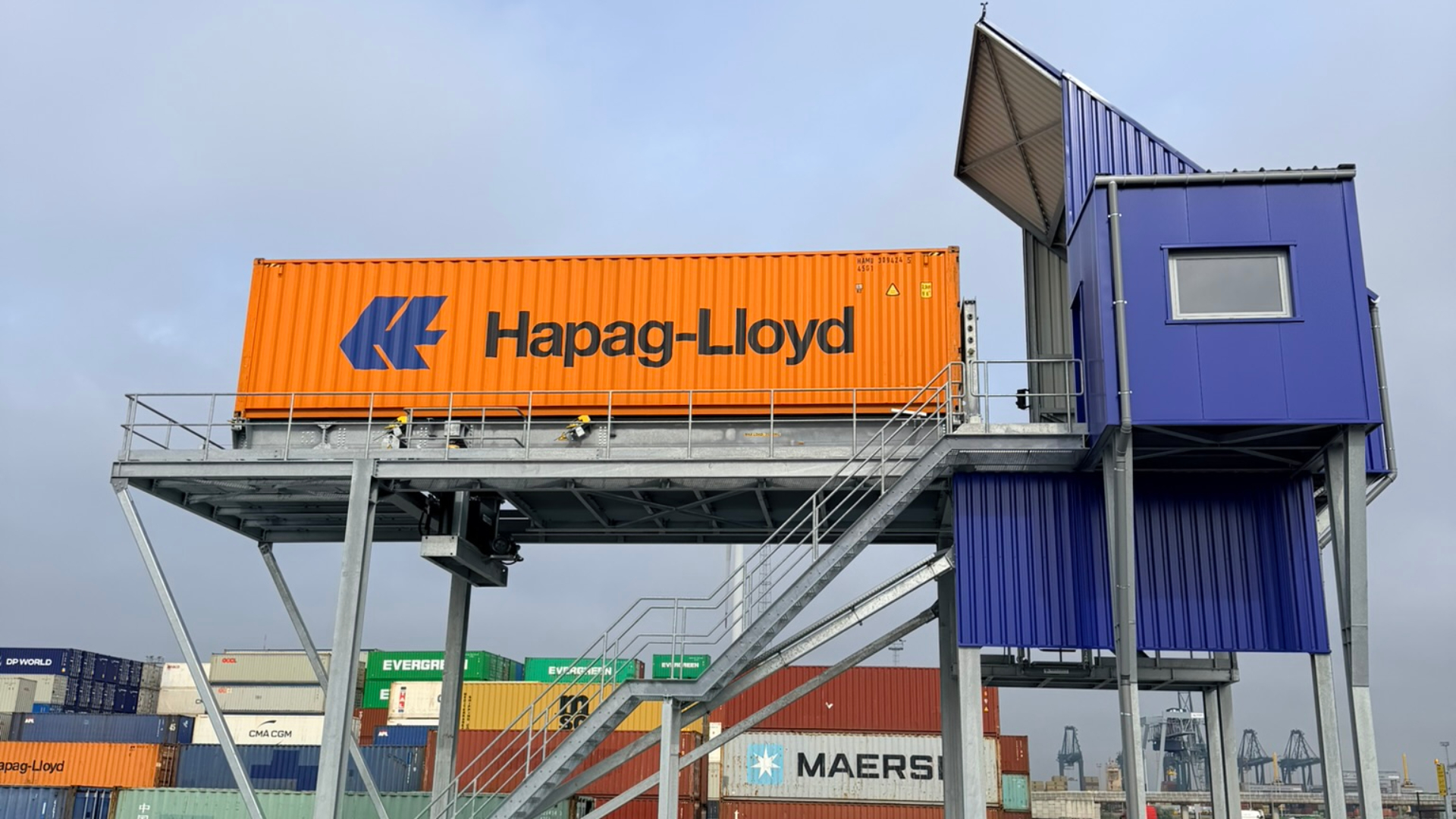
Maxpac supplied a hydraulic container tilt frame: a proven solution for containers weighing up to 35 tons.

Discover the case
A new polymer terminal

Safely and Precisely Unloading Full Shipping Containers weighing up to 35 tons

For a new polymer terminal, our customer needed a rugged system capable of safely tilting heavy, fully loaded shipping containers and transferring the product directly into trucks. Maxpac supplied a hydraulic container tilt frame: a proven solution for containers weighing up to 35 tons, integrated into the infrastructure and day-to-day operations of the new site.

An international logistics service provider with multiple terminals in Belgium, specializing in storage, transportation, distribution, and bulk handling for customers in the chemical and petrochemical industries, needed to equip a new logistics terminal for unloading shipping containers.

The site will be used to store, handle, and transfer polymers. The terminal has been designed with future customers in mind, with granulates and microgranulates expected to make up the majority of the products handled.

This required a rugged and safe unloading solution. Fully loaded containers needed to be handled in a controlled manner while transferring the product into trucks as efficiently as possible. At the same time, the system had to be suitable for intensive industrial use, with minimal product loss and a safe working environment for operators.

The container tilt frame is suitable for 20-, 30-, and 40-foot shipping containers with a maximum total weight of up to 35 tons.

The challenge

Controlling the entire unloading operation, not just tilting the container

At first glance, the requirement seemed straightforward: tilt a full shipping container so the product can flow out. In practice, several technical requirements had to come together.

The system needed to withstand the high loads associated with fully loaded containers. At the same time, the tilting motion had to remain controlled so that product flow could be managed throughout the unloading process. Under ideal conditions, the system is designed for a throughput of approximately two containers per hour.

The tilt frame also had to be integrated into a completely new terminal and connect seamlessly with the planned loading and unloading infrastructure.

Safety was a non-negotiable requirement. Operators work around equipment that moves very large loads. The mechanical structure, hydraulic drive, controls, and access to the system therefore had to be considered as one integrated whole.

Reliability and ease of maintenance were also important requirements. The system was intended for intensive use and therefore had to be built using rugged components suited to industrial operating conditions.

The challenge was not to develop an entirely new machine from scratch, but to engineer an integrated solution in which load capacity, product flow, safety, available space, and day-to-day operations all worked together.

Maxpac has delivered a substantial number of comparable container tilt frames. This allowed the customer to build on a concept that had already proven itself in other industrial applications.

The approach

Understand the operating environment first, then engineer the tilt frame

Maxpac began by analyzing the logistics flow and required unloading capacity. Based on that operating context, the team determined how the container tilt frame, support structure, and hydraulic system needed to be integrated into the new terminal.

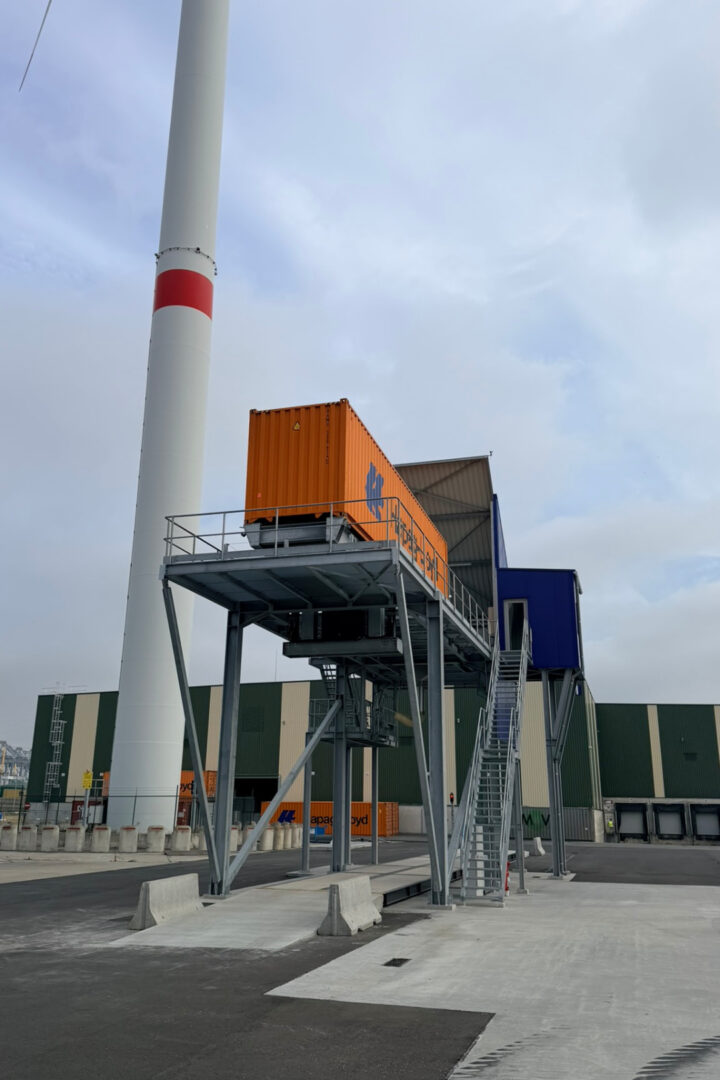
The solution consists of a hydraulic container tilt frame that allows a complete shipping container to be tilted in a controlled manner. As the container is raised to an increasing angle, the polymers can flow into the unloading system below and then be loaded directly into trucks.

The tilt frame can raise containers to an angle of up to 60°.

Although the tilt frame itself is a proven solution, the complete installation still had to be properly matched to the available space, required unloading height, container types used, loading and unloading infrastructure, required capacity, and the customer’s safety requirements.

The engineering work therefore focused primarily on integrating the system into the new terminal. The position and geometry of the tilt frame and its supporting structure directly affect how containers can be brought in, tilted, and unloaded, as well as how the product flow connects to the rest of the process.

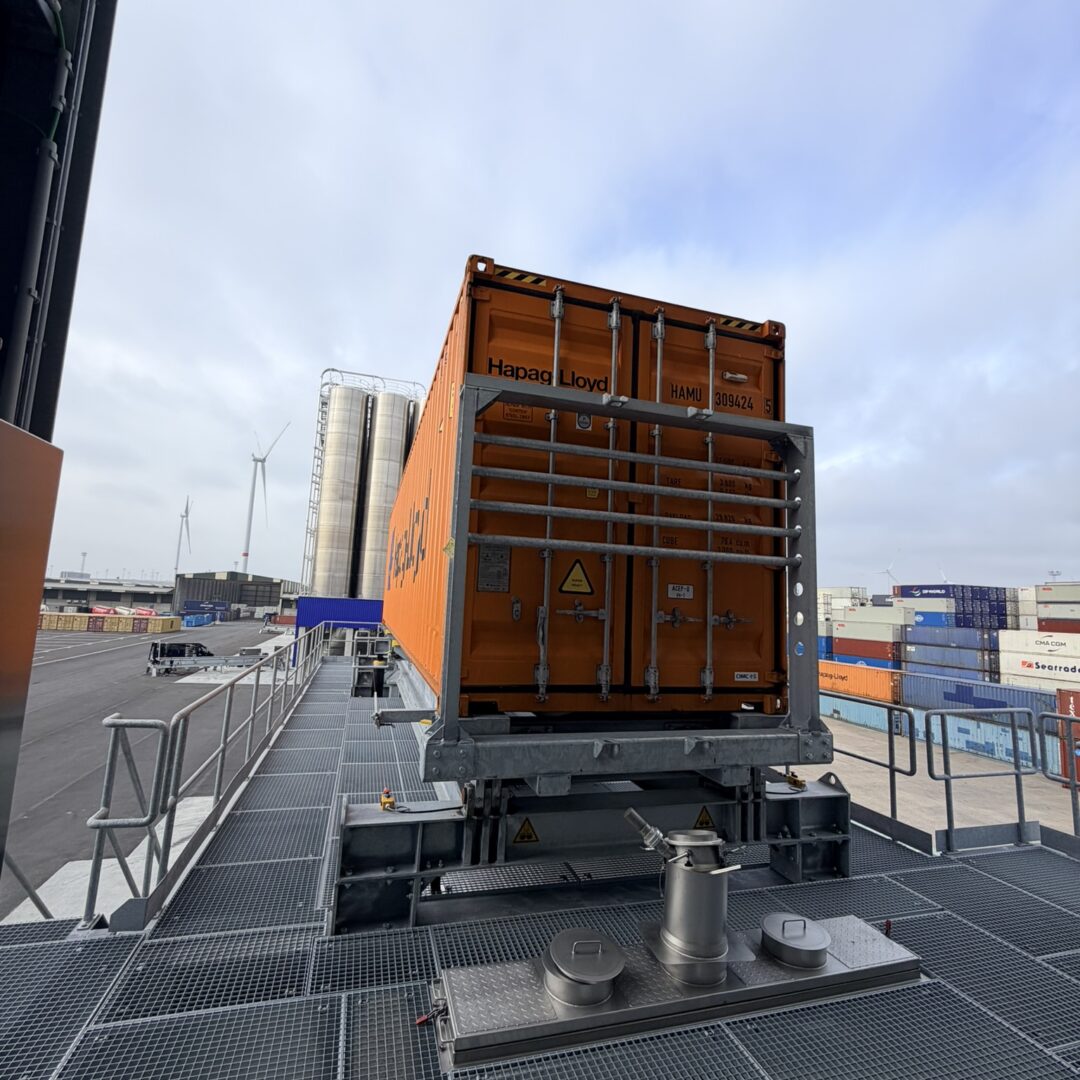
To handle the high loads involved, the tilt frame is built as a heavy-duty steel structure with a generous safety factor. Tilting is performed by a rugged hydraulic system using industrial-grade components.

The installation also includes PLC controls, an operator panel, an electrical control cabinet, and sensors for position detection. Safety guards, emergency stops, and controlled access help support safe operation. The safety provisions were implemented in accordance with the applicable CE requirements.

Maxpac also engineered the steel support structure. Its fabrication was carried out in cooperation with a steel contractor selected by the customer. This allowed the tilt frame and its supporting structure to be developed as one integrated installation within the site.

The process

From 3D engineering to startup

An implementation period of 6 months.


Step 1

3D-engineering

Following the process analysis, the complete installation was engineered in 3D. Structural calculations were performed, and the team verified how the system needed to be integrated into the new site.

Step 2

Production and preparation

Production and preparation of the mechanical, hydraulic, and electrical systems followed.


Step 3

Installation

After transport to the terminal, the system was mechanically installed. During startup, the equipment and software were calibrated and the tilt frame was extensively tested. The tests involved several container types, including testing at the maximum specified load. The installation’s safety functions were also verified before the system was put into operation.

Step 4

Training

The final step was training the operators and technical team. This ensured that the project delivered not only the equipment itself, but also the knowledge required to operate the system safely in daily operations.


The result

A controlled path from container to truck

With the container tilt frame, the customer has a system that can hydraulically tilt full shipping containers and allow polymers to flow in a controlled manner into the unloading equipment below.

The setup supports direct transfer into trucks. Under ideal conditions, approximately two containers per hour can be processed.

One possible alternative unloading method is to tilt or unload the container using a vehicle or trailer positioned above a hopper, after which the product is pneumatically conveyed into a truck. This uses a vehicle for an operation it was not designed to perform as a machine and also requires an additional pneumatic conveying step. The container tilt frame provides a safer and more efficient industrial solution by allowing the container to be tilted in a controlled manner using equipment specifically designed for that purpose.

In terms of operational reliability, Maxpac can also draw on experience from a broader installed base. Several systems of this type are already in operation. Across these installations, Maxpac reports uptime of more than 99%. Aside from limited annual maintenance—mainly lubrication, inspection, and oil top-ups—there are few wear parts, and overall maintenance requirements are limited.

Frontaal zicht op container tipper van Maxpac in de haven van Antwerpen bij logistieke speler

Most importantly, the different functions were not treated as separate elements. Container handling, product flow, structural design, hydraulics, controls, and safety were considered together within the operating context of the terminal.

This reflects Maxpac’s broader approach to bulk-handling projects: when a proven solution is available, it forms the starting point. The engineering work then focuses on properly integrating that solution into the customer’s process, infrastructure, and safety environment.

Optimize your loading and unloading operations with the best container tipper

Contact us for a no-obligation consultation and discover how our container tipper can make your bulk handling operations safer and more efficient.

Book a consultation

Consult with our experts

Our packaging specialists are ready to assist you with the design, installation, startup, maintenance, and optimization of your packaging line.

Consult with our experts today, free of obligation. And see how you can achieve more reliability, efficiency, and return from your packaging line as soon as tomorrow.

Contact us

CEO / Managing Partner

Alex Govaert


We pack a punch

Stay ahead with these cases

Get inspired by our success stories in various sectors

Katoen Natie - Fertilizer

Smart Expansion and Modernization of Fertilizer Packaging Lines


How Katoen Natie Tessenderlo increases its packaging capacity with an efficient and future-proof solution from Maxpac and Concetti.

Discover the case
Aveno - Nutrients & Supplements

Compact flexible packaging line for fat flakes


Maxpac delivered a compact packaging line to Aveno. The packaging process for fat flakes now guarantees optimal efficiency.

Discover the case
Molens Joye - Mill

Compact packaging line for flour


Maxpac delivered a modern bagging line to Molens Joye. A compact and inventive solution that led to a major shift in their production flow.

Discover the case